


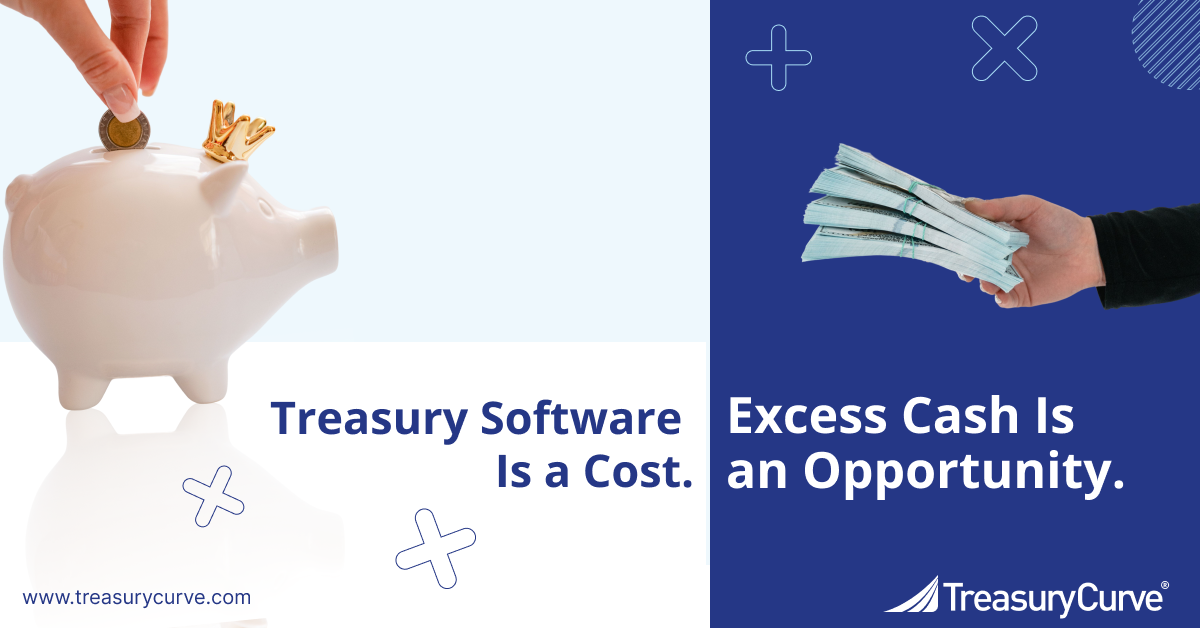
Treasury Software Is a Cost. Excess Cash Is an Opportunity.
Treasury Software Is a Cost. Excess Cash Is an Opportunity.
Every organization invests in technology. Finance systems. Enterprise resource planning (ERP) platforms. Customer Relationship Management (CRM) software. Cybersecurity solutions. Analytics tools. Treasury applications.
These investments are necessary to improve operations, support decision-making, and help organizations scale. They also share something in common: they represent expenses. Whether paid upfront, through annual licensing, or via subscription pricing, software requires organizations to commit financial resources today in the expectation that measurable value will be realized tomorrow.
That makes software an investment and a cost.
Cash, on the other hand, is different.
Cash is one of the few assets on the balance sheet that has the potential to create additional value when managed effectively. The challenge isn’t simply having cash. It’s understanding where that cash is, how much of it is truly available, and whether excess liquidity is being put to work in ways that support the organization’s financial objectives.
That’s why treasury leaders should think differently about technology investments.
Instead of asking, “What will this software cost us?” they should also be asking, “What opportunity are we missing with the cash we already have?”
Software Enables Better Decisions. Cash Creates Financial Opportunity.
Software plays an important role in modern treasury organizations. It improves visibility, streamlines workflows, automates repetitive tasks, strengthens controls, and provides better information for decision-making.
Those are meaningful advantages.
But software doesn’t create value by itself.
The value comes from the decisions people make using the information the software provides.
A treasury platform can display balances across hundreds of accounts, but it doesn’t generate investment income simply because those balances appear on a dashboard.
Likewise, automation doesn’t improve returns on excess liquidity by itself. Better information helps organizations evaluate liquidity and investment alternatives more effectively.
Understanding this distinction is important because it changes how organizations evaluate treasury technology. Instead of viewing software as the end goal, they begin viewing it as the tool that supports more effective cash management.
The Balance Sheet Doesn’t Care About Features
When organizations evaluate treasury technology, conversations often revolve around product capabilities.
- How many banks does it connect to?
- Does it support automated workflows?
- Can it integrate with our ERP?
- What reporting capabilities does it include?
These are all valid questions. But none of them appear on the balance sheet. The balance sheet reflects assets, liabilities, and equity, not dashboards, workflows, or user interfaces.
Cash, however, appears prominently.
That simple observation highlights an important truth: treasury technology should ultimately be evaluated based on how well it helps organizations manage one of their most important financial assets.
Features matter because they provide the information needed to evaluate opportunities.
The value comes from how organizations use that information.
Idle Cash Carries an Opportunity Cost
Many finance organizations think of idle cash as a low-risk position.
But idle cash also represents opportunity.
Without complete visibility into liquidity, organizations may maintain higher operating balances than necessary, delay investment decisions, or overlook excess cash that could potentially be invested according to organizational policies and objectives.
None of these situations necessarily reflect poor treasury management.
Instead, they often result from fragmented banking relationships, multiple operating entities, decentralized accounts, or limited visibility across the organization.
When treasury teams cannot quickly identify available liquidity, excess cash may remain idle simply because no one realizes it is available.
The cost isn’t just the idle balance.
The cost is the opportunity that balance represents.
Treasurers and CFOs See Opportunity Differently
Treasurers naturally concentrate on managing liquidity efficiently.
Their priorities include maintaining adequate cash to meet obligations, reducing operational risk, improving visibility, managing banking relationships, and ensuring investment decisions align with organizational policies.
CFOs certainly care about those objectives, but they often frame them differently. They ask:
- Are we making the best use of available capital?
- Are we maximizing financial flexibility?
- Are we allocating resources effectively?
- Are we supporting overall financial objectives?
- Are we creating value without adding unnecessary cost?
These aren’t competing priorities.
They’re complementary perspectives.
The treasurer manages liquidity.
The CFO evaluates the financial impact of that liquidity.
The organizations that perform best recognize that treasury technology should support both conversations simultaneously.
The ROI Conversation Should Include More Than Software
Technology purchases frequently begin with ROI analysis.
- Implementation costs.
- Subscription fees.
- Training expenses.
- Professional services.
- Support costs.
Organizations then estimate labor savings, process improvements, and productivity gains to determine whether the investment makes financial sense.
There is nothing wrong with this process.
The problem is that it often ignores a much larger variable.
What financial opportunity exists within the organization’s cash position today?
- Improved visibility into liquidity may allow treasury teams to identify potential excess cash sooner.
- More timely information may support evaluation of investment alternatives.
- Better access to cash data may improve capital allocation discussions across the finance organization.
These outcomes are different from operational efficiencies.
They focus on improving financial decision-making rather than simply reducing administrative effort.
Better Visibility Creates Better Information
One of the greatest challenges facing treasury organizations is information fragmentation. Cash is often spread across numerous financial institutions, business units, legal entities, operating accounts, and investment vehicles. Bringing all that information together quickly and accurately can be difficult. Without timely visibility, finance teams often make decisions using yesterday’s information.
Better visibility doesn’t eliminate uncertainty, but it can provide organizsations with more timely and complete information for decision-making.
- Treasury professionals gain a clearer understanding of available liquidity.
- Finance executives gain greater confidence when evaluating capital allocation decisions.
- Investment opportunities become easier to evaluate because organizations have more complete information.
Visibility doesn’t create value on its own.
It creates the conditions that allow organizations to better evaluate opportunities and liquidity needs.
Technology Should Support Financial Strategy
The most successful treasury organizations don’t invest in technology simply because it includes the newest features. They invest because technology supports broader financial objectives.
Those objectives might include:
- Improving liquidity management
- Strengthening cash visibility
- Supporting investment decisions
- Reducing operational complexity
- Enhancing financial controls
- Providing more timely information for finance leadership
Viewed through this lens, treasury software becomes part of a larger financial strategy rather than a standalone technology purchase. The software matters. But how organizations use the information matters more.
Shifting the Conversation
Imagine two organizations evaluating treasury technology.
The first spends most of its time comparing implementation timelines, subscription costs, integration capabilities, and product demonstrations.
The second asks a different set of questions.
- How much excess liquidity may already exist across our organization?
- How quickly can we identify it?
- How can better visibility support more informed liquidity decisions?
- How can we make more informed capital allocation choices?
Both organizations are evaluating technology. Only one begins with financial opportunity. That difference may ultimately shape not only which solution they choose, but also how they measure success after implementation.
A Different Perspective on Treasury Technology
Treasury Curve was built around this philosophy.
Rather than asking organizations to justify another software investment based solely on operational efficiencies, Treasury Curve helps treasury and finance teams gain greater visibility into cash, evaluate potential excess liquidity, and model hypothetical investment scenarios that support more informed financial decisions.
The platform is simply how those capabilities are delivered.
Because the real objective isn’t purchasing software. The goal is to help organizations better understand one of their most valuable assets and make more informed decisions about how that asset is managed.
If you’re interested in exploring the opportunity that may already exist within your organization, Treasury Curve’s Money Fund Calculator provides a simple way to model hypothetical investment scenarios using your own assumptions and available cash balances.
Instead of beginning with software costs, begin with your cash. You may discover that your greatest treasury opportunity has been on your balance sheet all along.
The Money Fund Calculator is provided for informational purposes only. Results are hypothetical estimates based on user inputs and assumptions and should not be considered investment advice or a guarantee of future performance.
Your cash balances may qualify you for our full suite of technology at no cost. Find out now.
*Any claims, statements or testimonials may not be representative of the experience of all clients and is no guarantee of future performance or success.
Investments like stocks, bonds, mutual funds and annuities are:
Not FDIC Insured | Not Bank Guaranteed | May Lose Value
Investments in money market funds are not guaranteed or insured by the Federal Deposit Insurance Corporation or any other government agency. While money market funds seek to maintain the value of your investment at $1.00 per share, it is possible to lose money by investing in these funds. The prospectus is available via the link to the asset manager on the Research page in the column entitled Fund Company URL. The prospectus contains more complete information about each Fund including distribution fees and expenses. An investor should read the prospectus carefully before investing or sending money.
Treasury Brokerage, LLC is a registered broker-dealer and a member FINRA/SIPC.
Securities offered by Treasury Brokerage, LLC a member of FINRA/SIPC. | brokercheck.finra.org

1.877.9TCURVE | info@treasurycurve.com